
Leaky gut solutions work best when they are personalized, not guessed. A calm stomach and weight changes can happen when hidden inflammatory triggers are identified, but food is rarely the only layer. What if the foods you keep choosing to heal your gut are part of what is keeping it inflamed?
At 2:14 p.m., you feel your waistband digging into your stomach again.
You ate “clean.” You skipped the obvious junk. Maybe you even started your morning with the breakfast everyone said was healing. But now your belly feels loud, swollen, unpredictable, and strangely exhausting.
And the weight? It is not responding the way it used to.
This is the part that makes people feel defeated: when they are doing the right things, but their body keeps acting like something is wrong.
Nikki S. came to us in that exact kind of confusion.
“
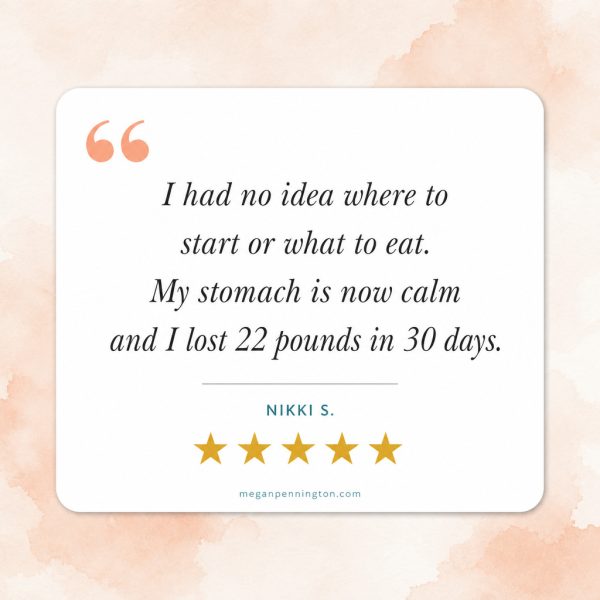
I consulted Megan for leaky-gut syndrome. I had no idea where to start or what to eat. Megan was very patient with me and answered all of my questions throughout the process. My stomach is now calm and I lost 22 pounds in 30 days.
— Nikki S.
★★★★★
Nikki’s results are her own, and we never want anyone to hear a story like this as a promise. But her words name something many people feel before they find the right support: “I had no idea where to start or what to eat.”
That sentence matters.
Because when your gut is inflamed, random guessing can make you feel trapped inside your own kitchen.
Why your stomach may not calm down with generic gut advice
Most people with gut issues have already tried the obvious things.
Less gluten. Less dairy. More probiotics. More fiber. Cleaner meals. More water. Maybe a strict elimination diet that helped for two weeks, then stopped working.
The uncomfortable truth is this: “healthy” is not the same as compatible with your immune system.
A food can be organic, anti-inflammatory on paper, and still trigger inflammatory mediator release in your body. That does not mean the food is bad. It means your immune system may be reacting to it right now.
This is where many leaky gut solutions fall short. They assume everyone needs the same gut-healing diet. But chronic bloating, stomach pain, fatigue, skin flares, migraines, and stubborn weight can be driven by hidden food and chemical triggers that are highly individual.
Two people can both have leaky gut symptoms and need completely different food plans.
The weight connection people rarely explain clearly
When the gut lining is irritated and the immune system is activated, the body is not simply “bad at burning calories.”
Inflammation can influence fluid retention, insulin signaling, cravings, energy production, bowel motility, and stress hormones. It can make your body feel puffy, tired, reactive, and resistant.
That is why some people feel like they are eating carefully but still gaining weight or unable to lose it.
This is not about willpower. It is not about needing more discipline. It may be about a body that has been stuck in an inflammatory loop for too long.
Signs that food-driven inflammation may be part of the picture include:
- Bloating or stomach discomfort after meals that seem healthy
- Weight that feels resistant despite consistent effort
- Fatigue, brain fog, headaches, joint aches, or skin flares that come and go
- Feeling overwhelmed because every food list seems to contradict the last one
This is why we do not start with another generic list.
We start by asking: what is your immune system responding to?
What a more personalized path can look like
In our work, leaky gut solutions are not built around guessing.
We often use specialized functional testing, including MRT food sensitivity testing and the LEAP protocol, to help identify inflammatory food and chemical triggers. From there, we build a customized nutrition plan designed to reduce immune activation while supporting gut repair.
But food is only one piece.
Our approach may also include microbiome rebalancing, gut-healing strategies, custom supplement recommendations, lifestyle support, and nervous system regulation. Because the gut and nervous system are deeply connected, a body that feels chronically unsafe may stay inflamed even when the diet improves.
That is the overlooked layer.
Chronic stress can keep the immune system on alert. Unresolved emotional patterns, trauma, and subconscious stress responses can continue sending “danger” signals through the body. For some clients, deeper healing includes somatic practices, medical hypnotherapy, inner child work, trauma repair, and nervous system recalibration.
Not because symptoms are “in your head.”
Because your body is listening to everything: food, microbes, hormones, stress chemistry, sleep, emotions, and the subconscious patterns that shape your physiology.
The goal is not restriction forever
The goal is not to make your world smaller.
The goal is to calm the system enough that your body can stop fighting every meal.
When inflammation begins to settle, people often describe ordinary moments that feel extraordinary: sitting through a workday without unbuttoning their pants, going out to dinner without fear, waking up without that heavy swollen feeling, trusting their stomach again.
For someone like Nikki, the win was not just a number on the scale. It was, “My stomach is now calm.”
That is the kind of change people are really craving.
A body that feels quieter. A plan that finally makes sense. A way forward that does not depend on guessing.
FAQ
What are the best leaky gut solutions if nothing has worked?
The best leaky gut solutions are usually personalized, not one-size-fits-all. If symptoms keep coming back, hidden food sensitivities, microbiome imbalance, chronic stress, and nervous system dysregulation may all need to be addressed together.
Can leaky gut make it harder to lose weight?
Leaky gut and chronic inflammation may contribute to fluid retention, cravings, fatigue, and metabolic stress. Weight changes are complex, but calming food-driven inflammation and supporting gut repair can be an important part of the picture for some people.
How is MRT and LEAP different from a regular elimination diet?
A regular elimination diet usually removes common foods based on general rules. MRT testing and the LEAP protocol are designed to help identify your specific inflammatory food and chemical triggers, so the plan is more targeted and less random.
If Nikki’s story made you wonder whether your gut symptoms and weight resistance have a shared root, that curiosity matters. Our team would love to show you how personalized testing, gut healing, and mind-body support can fit together.
Ready to get to the root cause? Watch our free Masterclass