
Chronic symptoms are often real signs of immune activation, inflammatory food triggers, gut disruption, and nervous system stress working together. When the right triggers are identified and the body is supported as a whole, symptoms can shift in ways that feel almost impossible after years of trying. But why can someone eat well, take supplements, see doctors, and still feel inflamed?
It is 2:00 p.m., and you are staring at the same unfinished task you promised yourself you would complete before lunch.
Your stomach feels swollen. Your energy is gone. Your skin, joints, head, or digestion is doing that familiar thing again. You ate carefully. You took the “right” supplements. Maybe your labs even looked normal.
And still, your body feels like it is fighting something.
That is the part that makes people quietly doubt themselves. Not because they want to. Because when chronic symptoms keep returning despite doing everything “right,” it starts to feel like there must be something wrong with you.
There may be a different answer.
“
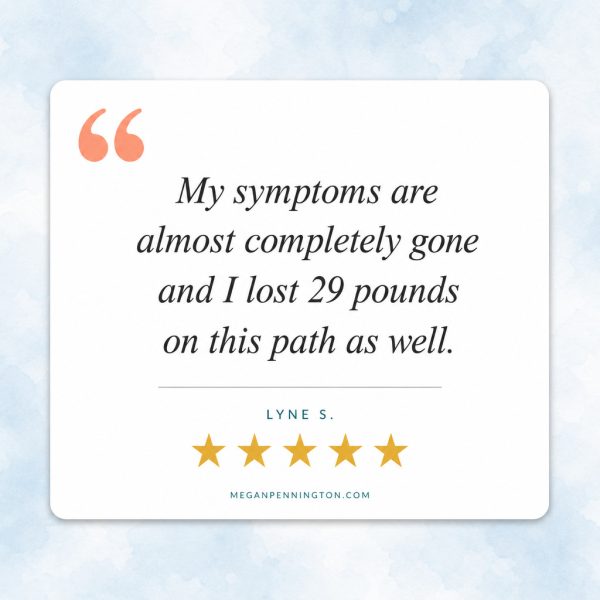
Megan is wonderful! She has helped guide me to a higher path of wellness and I feel so much better now. My symptoms are almost completely gone and I lost 29 pounds on this path as well. Thank you Megan.
— Lyne S.
★★★★★
Lyne’s words are simple, but they point to something we see often: when inflammation begins to quiet down, the body can change in more than one way.
Symptoms ease. Energy returns. Digestion settles. Weight that felt stubborn may begin to shift because the body is no longer living in a state of constant defense.
That does not mean every person will have the same result. It means the body often responds differently when we stop guessing and start identifying what is keeping the immune system activated.
Why symptoms can persist when you are doing everything right
One of the most frustrating beliefs we need to flip is this: if a food is healthy, it must be healthy for you.
That is not always true.
A food can be nutrient-dense and still act like an inflammatory trigger for your unique immune system. Salmon, spinach, avocado, blueberries, almonds, eggs, turmeric, or fermented foods can be wonderful for one person and irritating for another.
This is where many people get stuck. They are not eating “badly.” They are eating foods that look perfect on paper, while their immune system is reacting underneath the surface.
Hidden inflammatory food and chemical triggers can contribute to:
- Bloating that appears even after clean meals
- Fatigue, brain fog, or that heavy afternoon crash
- Skin flares, migraines, joint aches, or digestive urgency
- Weight resistance that does not match your effort
These chronic symptoms are not random. They are often signs that the body’s inflammatory messaging system is still switched on.
The missing piece is often personalization
Most elimination diets are based on common categories: gluten, dairy, soy, corn, eggs, nightshades, or sugar.
Sometimes that helps. Sometimes it does not.
The problem is that the immune system is not generic. Two people with bloating and fatigue may have completely different inflammatory triggers. One may react to a food they eat every day. Another may need gut healing, microbiome rebalancing, nervous system regulation, and a calmer stress response before their body can fully respond.
In our practice, we use precision functional testing, including MRT food sensitivity testing and the LEAP protocol when appropriate, to help identify food and chemical triggers that may be provoking inflammation. But testing is not the whole plan.
It is one part of a whole-person process.
We also look at digestion, gut barrier function, microbiome patterns, nutrient needs, lifestyle stressors, custom supplement recommendations, and the stress-inflammation connection. Because if the body is inflamed, guarded, exhausted, and dysregulated, food is rarely the only conversation.
The goal is not to eat less. The goal is to stop repeatedly provoking the immune system.
Why the nervous system matters when symptoms will not let go
There is another layer many people have never been taught to consider.
The gut and nervous system are deeply connected. Chronic stress can keep the immune system in a heightened state of activation. Unresolved trauma, old emotional patterns, and subconscious stress responses can keep the body bracing, even when life looks fine from the outside.
This does not mean your symptoms are “in your head.”
It means the brain, gut, immune system, hormones, and emotions are in constant conversation.
When the nervous system is stuck in survival mode, the body may digest poorly, react more strongly, sleep less deeply, hold inflammation longer, and struggle to release weight. That is why our approach may include somatic practices, medical hypnotherapy, nervous system recalibration, inner child healing, and trauma repair when those layers are relevant.
For many clients, deeper healing means addressing both the physical triggers and the subconscious patterns that keep the body on high alert.
Your symptoms are real. And your body may need more than another supplement protocol.
What improvement can actually feel like
When the right pieces come together, changes can feel surprisingly practical.
You may notice you wake up clearer. Meals feel less risky. The afternoon crash is softer or gone. Bloating is no longer the thing that decides whether you wear jeans. Your skin calms. Your head feels lighter. You stop planning your life around what your body might do next.
For some people, weight begins to shift too, not because they forced their body harder, but because inflammation, fluid retention, cravings, blood sugar swings, and stress chemistry are no longer driving the same cycle.
This is why Lyne’s testimonial matters. “My symptoms are almost completely gone and I lost 29 pounds” is not just about a number. It reflects a body that finally received more precise information and better support.
Chronic symptoms often improve when we stop treating the body like a puzzle with one missing piece and start looking at the whole system.
The path is not more guessing
If you have already tried eating clean, removing obvious foods, taking probiotics, changing supplements, and pushing through fatigue, it may be time for a more specific map.
Our programs are designed to connect the dots between inflammation, food sensitivity testing, gut healing, microbiome rebalancing, custom support, lifestyle patterns, and mind-body healing. MRT and LEAP may be part of that map. Nervous system regulation may be part of it too.
The point is to understand what your body is reacting to and what it needs in order to feel safe enough to repair.
FAQ
Can chronic symptoms really come from food sensitivity?
Yes, some chronic symptoms can be driven by inflammatory food and chemical sensitivities that are unique to your immune system. These reactions can contribute to bloating, fatigue, migraines, skin issues, joint pain, and brain fog even when the foods seem healthy.
Why would weight change when inflammation improves?
Inflammation can influence fluid retention, cravings, blood sugar stability, digestion, stress hormones, and metabolic signaling. When the immune system is less activated and the body is better supported, weight may begin to shift more naturally for some people.
Is MRT and LEAP only about removing foods?
No. MRT and the LEAP protocol can help identify and organize food and chemical triggers, but our approach is broader than food removal. We also consider gut function, microbiome health, supplements, lifestyle, nervous system regulation, and mind-body healing when needed.
If you are wondering which foods, stress patterns, gut issues, or nervous system signals may be keeping your inflammation active, we would love to help you understand the bigger picture. Ready to get to the root cause? Watch our free Masterclass