
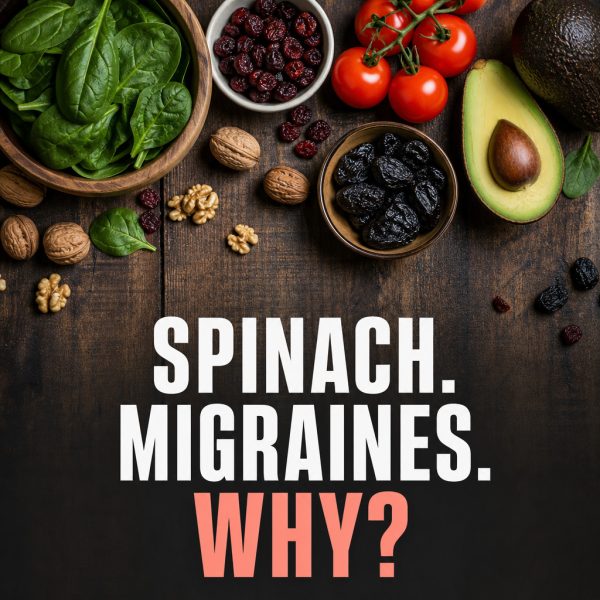
Food chemical sensitivity can explain why someone can eat a clean, whole-food diet and still have migraines, bloating, fatigue, rashes, joint pain, or autoimmune flares. Naturally occurring food chemicals like salicylates, amines, glutamates, and sulfites can activate inflammation in sensitive immune systems. The uncomfortable question is this: what if the problem is not the quality of your food, but how your immune system is reacting to specific chemicals inside it?
You make the salad.
Spinach, avocado, tomato, olive oil, maybe leftover salmon. Nothing processed. Nothing “bad.” The kind of meal you were told should calm inflammation.
Then two hours later, your stomach looks six months pregnant. Your face feels hot. A migraine starts behind one eye. Your energy drops so hard you start bargaining with yourself about how soon you can lie down.
And the worst part is not the symptom itself.
It is the confusion.
Because when you are already eating carefully, avoiding obvious junk, taking the supplements, checking the labels, and doing what every practitioner told you to do… reacting to “good” food can make you feel like your body is impossible to understand.
It is not.
The missing category: food chemicals
Most people are taught to think about food reactions in one of three ways: allergies, intolerances, or digestive problems.
But there is another category that often gets missed: naturally occurring food chemicals.
These are not additives. They are not pesticides. They are not signs that the food is unhealthy.
They are compounds that exist naturally in plants, fermented foods, aged foods, fruits, vegetables, herbs, spices, and protein-rich foods. For many people, they are handled without a problem. But in some immune systems, they can contribute to chronic inflammatory symptoms.
Common food chemicals include:
- Salicylates, found in many fruits, vegetables, herbs, spices, teas, and some nuts.
- Amines, often higher in aged, fermented, smoked, or very ripe foods.
- Glutamates, naturally present in foods like tomatoes, mushrooms, aged cheeses, broths, and some fermented foods.
- Sulfites, which may occur naturally or be added to foods like wine, dried fruit, vinegar, and some packaged items.
This is why one person can feel amazing on a big colorful salad, while another feels inflamed, foggy, itchy, anxious, swollen, or exhausted afterward.
Food chemical sensitivity is not about whether a food is “good” or “bad.” It is about whether your immune system is currently able to tolerate it.
The belief that keeps people stuck
Here is the belief we often have to challenge gently but directly:
If a food is whole, natural, and nutrient-dense, it must be safe for an inflamed body.
Not always.
A “clean” diet can still be high in salicylates, amines, glutamates, or sulfites. Smoothies, green juices, kombucha, bone broth, avocado, spinach, berries, tomatoes, fermented vegetables, dark chocolate, and leftovers can all be nourishing foods.
They can also be symptom triggers for the wrong person at the wrong time.
That does not mean those foods are universally harmful. It means your body may be giving specific feedback that has not been decoded yet.
This is where many people lose years.
They remove gluten. Then dairy. Then sugar. Then eggs. Then grains. Then nightshades. Their diet gets smaller and smaller, but symptoms still break through because the real pattern was not being tracked.
Food chemical sensitivity often creates reactions that feel random because the trigger may not be the food name. It may be the chemical load, the portion size, the freshness of the food, the combination of foods, or the state of your immune and nervous system that day.
Why symptoms can show up hours later
Inflammation is not always instant.
With food chemical sensitivity, the immune system may release inflammatory mediators over time. Think of it like a smoke alarm that is overly sensitive. One piece of toast may not set it off. But toast, stress, poor sleep, a high-salicylate smoothie, and a tense workday may all create enough “smoke” for the alarm to start blaring.
That inflammatory response may show up as:
- Bloating, reflux, cramping, loose stools, or constipation.
- Migraines, brain fog, dizziness, or pressure in the head.
- Skin flushing, eczema, hives, acne-like flares, or itching.
- Fatigue, joint pain, mood shifts, anxiety, or poor sleep.
This is also why food journals can be so frustrating. You may blame dinner when the inflammatory bucket was filling all day.
Why testing can matter
At MP Integrative Health, we do not believe people should have to guess forever.
Specialized testing, including MRT food sensitivity testing and the LEAP protocol when appropriate, can help identify immune-mediated food and chemical triggers with more precision than broad elimination diets alone.
But this is important: MRT and LEAP are tools, not the whole solution.
Our approach looks at the bigger picture: nutrition, gut healing, microbiome rebalancing, custom supplement recommendations, lifestyle support, and the stress-inflammation connection. Because food chemical sensitivity may be one driver, but the body rarely becomes inflamed for only one reason.
If your gut lining is irritated, your microbiome is disrupted, your immune system is on high alert, or your nervous system is stuck in survival mode, your tolerance for food chemicals may drop.
That is not a character flaw.
It is physiology.
The nervous system piece people do not expect
Many clients come to us focused only on food. That makes sense. Food reactions are tangible. They are easier to track than the deeper patterns underneath.
But chronic stress, unresolved trauma, emotional suppression, hypervigilance, and long-term nervous system dysregulation can keep the immune system primed for reaction.
The gut and nervous system speak constantly through the gut-brain axis. When the body does not feel safe, digestion changes. Motility changes. Microbial balance changes. Inflammatory signaling can increase. Tolerance can shrink.
This is why deeper healing may include mind-body healing, somatic practices, medical hypnotherapy, inner child healing, trauma repair, and nervous system recalibration alongside nutrition and testing.
Not because your symptoms are “in your head.”
Because your brain, gut, immune system, and subconscious stress responses are part of the same body.
Your symptoms are real. And a whole-person approach gives us more places to intervene.
What improvement can feel like
When the right triggers are identified and the body’s inflammatory load begins to come down, people often describe something simple but profound: life feels less unpredictable.
Meals stop feeling like a threat.
The 2pm crash softens. The bloat is not as constant. The migraine pattern starts to make more sense. Skin calms. Sleep becomes easier. Energy returns in a way that feels steadier, not forced.
And perhaps most importantly, people begin to trust their body again.
Food chemical sensitivity does not mean you are destined to avoid long lists of foods forever. In many cases, the goal is to reduce inflammation, calm the immune system, repair the gut, support the microbiome, regulate the nervous system, and then carefully rebuild tolerance where possible.
That path has to be personalized.
Because your triggers, your stress physiology, your gut history, your emotional patterns, and your immune system are not generic.
FAQ
What is food chemical sensitivity?
Food chemical sensitivity happens when the body reacts to naturally occurring compounds in foods, such as salicylates, amines, glutamates, or sulfites. These reactions are not the same as classic food allergies, and symptoms may appear hours later as inflammation builds.
Can whole foods cause inflammation?
Yes, whole foods can trigger inflammation in certain people if their immune system is sensitive to specific food chemicals or proteins. This does not make the food unhealthy for everyone; it means the person’s current tolerance and inflammatory load matter.
How do I know if salicylates, amines, glutamates, or sulfites are affecting me?
Patterns can sometimes be identified through careful history, symptom tracking, and specialized testing. Because symptoms can overlap with gut issues, stress physiology, microbiome imbalance, and immune activation, we prefer a personalized root-cause approach rather than random restriction.
If you are reacting to foods that should be helping you, your body may be asking for a more precise map. Our team looks at food chemical sensitivity, immune activation, gut health, microbiome patterns, and nervous system regulation together so the plan actually fits your body.
Ready to get to the root cause? Watch our free Masterclass